NetOpsBench v0.2.0 Results
Seven-scale DeepSeek release validation, diagnosis quality, observability, and cost.
This page reports the current NetOpsBench v0.2.0 release snapshot. It is a reproducible benchmark reference, not a permanent model ranking: provider behavior, prompts, tool policy, and benchmark contracts can change absolute values.
| Experiment | Configuration |
|---|---|
| Agent | minimal-deepagent |
| Model | deepseek-v4-pro, thinking disabled, temperature 0 |
| Benchmark contract | netopsbench-0.2-release |
| Coverage | 7 topology scales, 319 operational cases |
| Validity | 319 / 319 case-valid and Agent-scored |
| Traces | 319 Harbor/ATIF v1.7 trajectories |
Results at a glance
Diagnosis score is the mean verdict-gated case score. Healthy cases require the correct verdict; fault cases receive localization credit only after the fault is detected. Fault detection F1 measures the fault-versus-healthy decision independently.
| Scale | Cases | Diagnosis score (%) | Fault detection F1 (%) | Device loc. (%) | Interface loc. (%) | Input tokens (K) | Time (s) |
|---|---|---|---|---|---|---|---|
| XS | 14 | 75.0 | 95.7 | 75.0 | 57.1 | 174.3 | 61.3 |
| Small | 15 | 83.3 | 95.7 | 83.3 | 57.1 | 221.4 | 65.1 |
| Medium | 28 | 71.4 | 85.7 | 70.8 | 42.9 | 298.4 | 79.6 |
| Large | 52 | 70.2 | 84.3 | 68.8 | 42.9 | 405.7 | 84.3 |
| Xlarge | 70 | 56.4 | 81.1 | 56.1 | 30.0 | 727.8 | 97.5 |
| Fat-tree K=8 | 70 | 63.6 | 80.0 | 63.6 | 45.0 | 594.7 | 102.9 |
| Fat-tree K=12 | 70 | 55.0 | 73.1 | 56.1 | 27.5 | 784.3 | 102.9 |
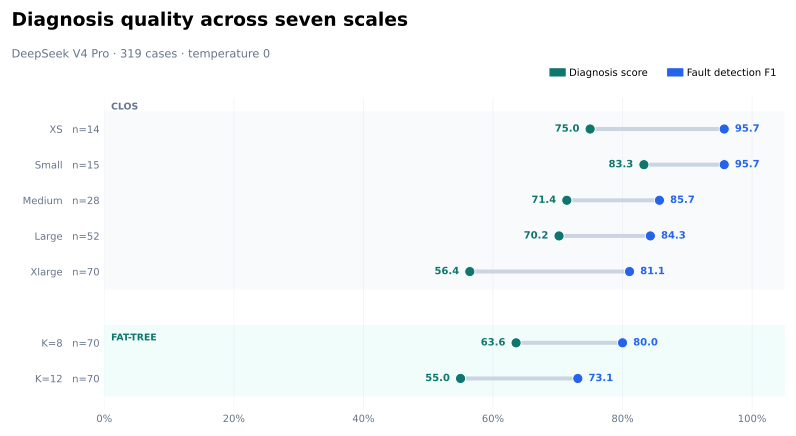
Three results define the release snapshot:
- Healthy precision is stable: all 25 / 25 healthy cases had zero formal Pingmesh anomaly and were diagnosed as healthy.
- Diagnosis quality falls with topology size. CLOS Diagnosis score decreases from 75.0% on XS to 56.4% on Xlarge; Fat-tree decreases from 63.6% on K=8 to 55.0% on K=12.
- Device localization is usually strong after the Agent commits to a fault. The main loss is missed detection or non-termination; interface localization remains the weakest quality dimension on the largest topologies.
Where diagnosis breaks down
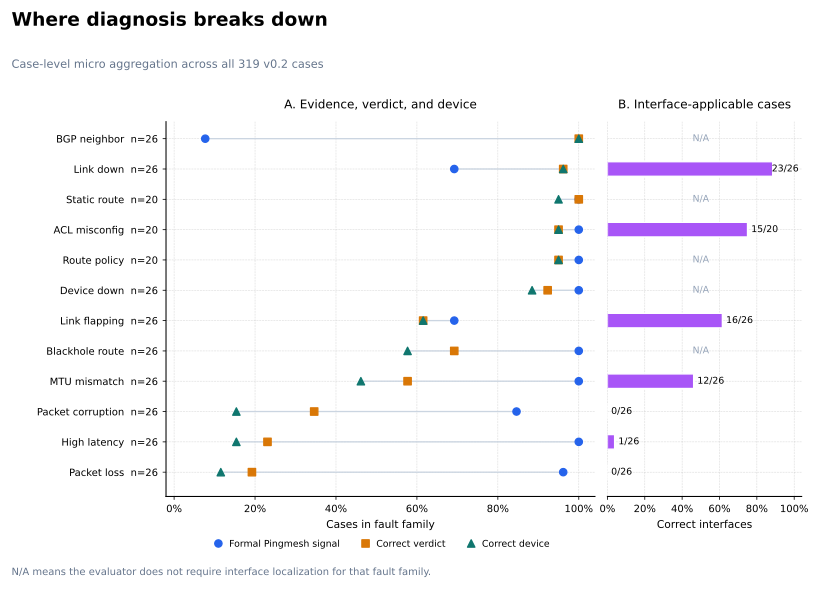
The following figure separates the evidence available to the Agent from the Agent's verdict and localization. Each point is a case-level micro average across all 319 cases; interface accuracy uses only cases for which the evaluator requires an interface.
| Fault family | Formal signal | Correct verdict | Correct device | Correct interface |
|---|---|---|---|---|
| High latency | 26 / 26 | 6 / 26 | 4 / 26 | 1 / 26 |
| Packet loss | 25 / 26 | 5 / 26 | 3 / 26 | 0 / 26 |
| Packet corruption | 22 / 26 | 9 / 26 | 4 / 26 | 0 / 26 |
| MTU mismatch | 26 / 26 | 15 / 26 | 12 / 26 | 12 / 26 |
| Link down | 18 / 26 | 25 / 26 | 25 / 26 | 23 / 26 |
| BGP neighbor | 2 / 26 | 26 / 26 | 26 / 26 | N/A |
This is the central quality finding: data-plane impairment evidence is usually present, but the Agent often fails to convert it into a fault verdict. By contrast, BGP neighbor faults rarely create endpoint Pingmesh anomalies under ECMP, yet the Agent diagnoses them reliably from control-plane telemetry. Pingmesh is therefore evidence, not the only source of truth.
Trace review identifies three recurring failure modes:
- The Agent mixes episode-window evidence with recovered live state.
- A single successful live ping is used to dismiss historical multi-hash Pingmesh loss.
- Transit attribution expands into an undirected device search and sometimes reaches the graph recursion limit.
Large-topology behavior
Xlarge, Fat-tree K=8, and Fat-tree K=12 contributed 210 / 210 valid observations and Agent results. All had complete Pingmesh coverage, successful injection/recovery and cleanup, zero unexplained local probe-error cases, and four clean healthy cases per topology.
| Topology | Switches | Clients | Paths | Cases | Operational | Agent-scored |
|---|---|---|---|---|---|---|
| Xlarge CLOS | 144 | 128 | 16,256 | 70 | 70 / 70 | 70 / 70 |
| Fat-tree K=8 | 80 | 128 | 16,256 | 70 | 70 / 70 | 70 / 70 |
| Fat-tree K=12 | 180 | 144 | 20,592 | 70 | 70 / 70 | 70 / 70 |
Upper-fabric link-down and link-flapping can produce zero or only a few endpoint anomalies when ECMP reconverges before enough full-window probes are lost. The physical fault is still visible in interface and BGP telemetry. Packet corruption is similarly hash-selective because the impairment applies to one selected egress member.
Access faults retain the expected blast radius: an isolated client affects 2 × (client_count - 1) directed paths—254 paths on Xlarge and K=8, and 286 paths on K=12. High-latency and MTU faults remain well separated from healthy observations: Xlarge recorded 12–17 latency paths and 57–97 DF-loss paths, while K=12 recorded 169–242 and 247–302 respectively.
Fat-tree K=12 case-level deep dive
The largest validated Fat-tree profile provides a compact view of every case. Outcome colors are mutually exclusive; “complete” means fully localized for a fault case or correctly healthy for a negative case.
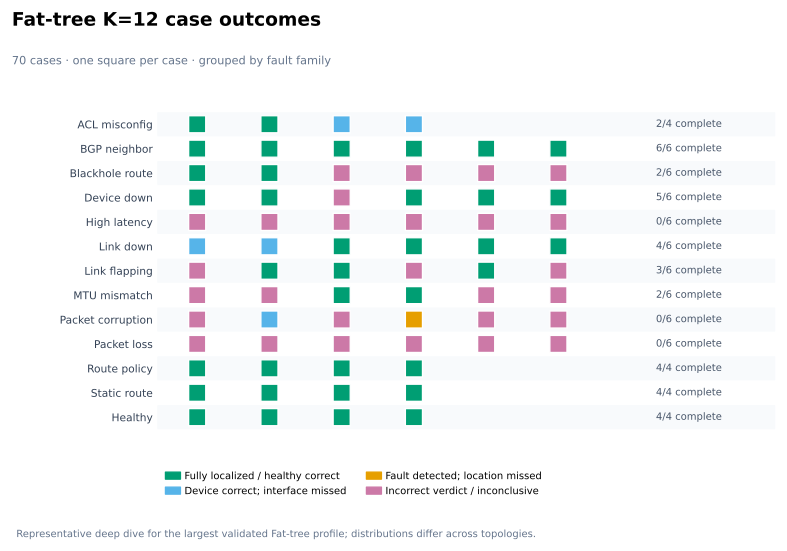
The K=12 distribution is a representative deep dive, not a substitute for the per-topology aggregates above.
Diagnosis cost
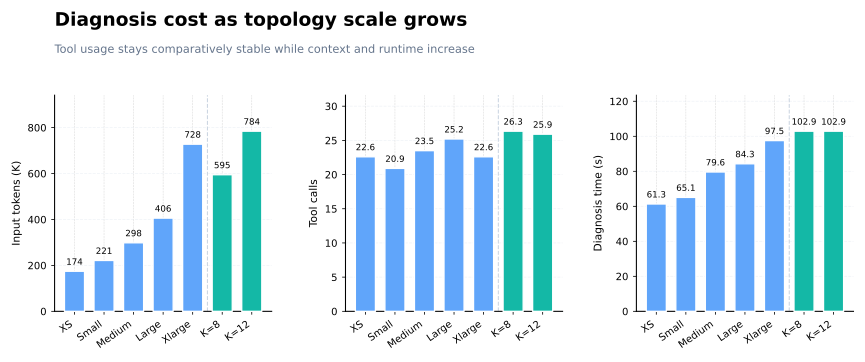
Tool calls remain in a narrow range—20.9 to 26.3 per case—while average input context grows from 174K tokens on XS to 784K on K12. Diagnosis time rises from 61.3 seconds to approximately 103 seconds. The primary scaling cost is therefore evidence and topology volume, not an explosion in the number of tool calls.
Reproducibility
| Snapshot | Agent trajectories | Selection |
|---|---|---|
| XS–Large | 109 | Four complete scale runs |
| Xlarge | 70 | Valid results selected by scenario ID from the canonical composite |
| Fat-tree K=8 | 70 | 16 completed initial results plus 54 completed resumed results |
| Fat-tree K=12 | 70 | Canonical composite including the validated access-link retry |
| Total | 319 | One scoring sidecar per Agent trajectory |
Only infrastructure/API-invalid attempts were replaced. Successful original Agent attempts were not rerun or substituted. Two unfinished K8 orphan traces were excluded because they never completed post-recovery validation.
The machine-readable release snapshot, fault-family analysis snapshot, and K12 case snapshot contain the plotted numerators, denominators, provenance, and archive references. All seven archives and their SHA-256 values are published in the NetOpsBench Trace Dataset v0.2 release.